We're building a scalable, open-source blueprint for thriving rural communities.
1,000+ residents in 12 months through emergent infrastructure, land trusts, and subscription economics.
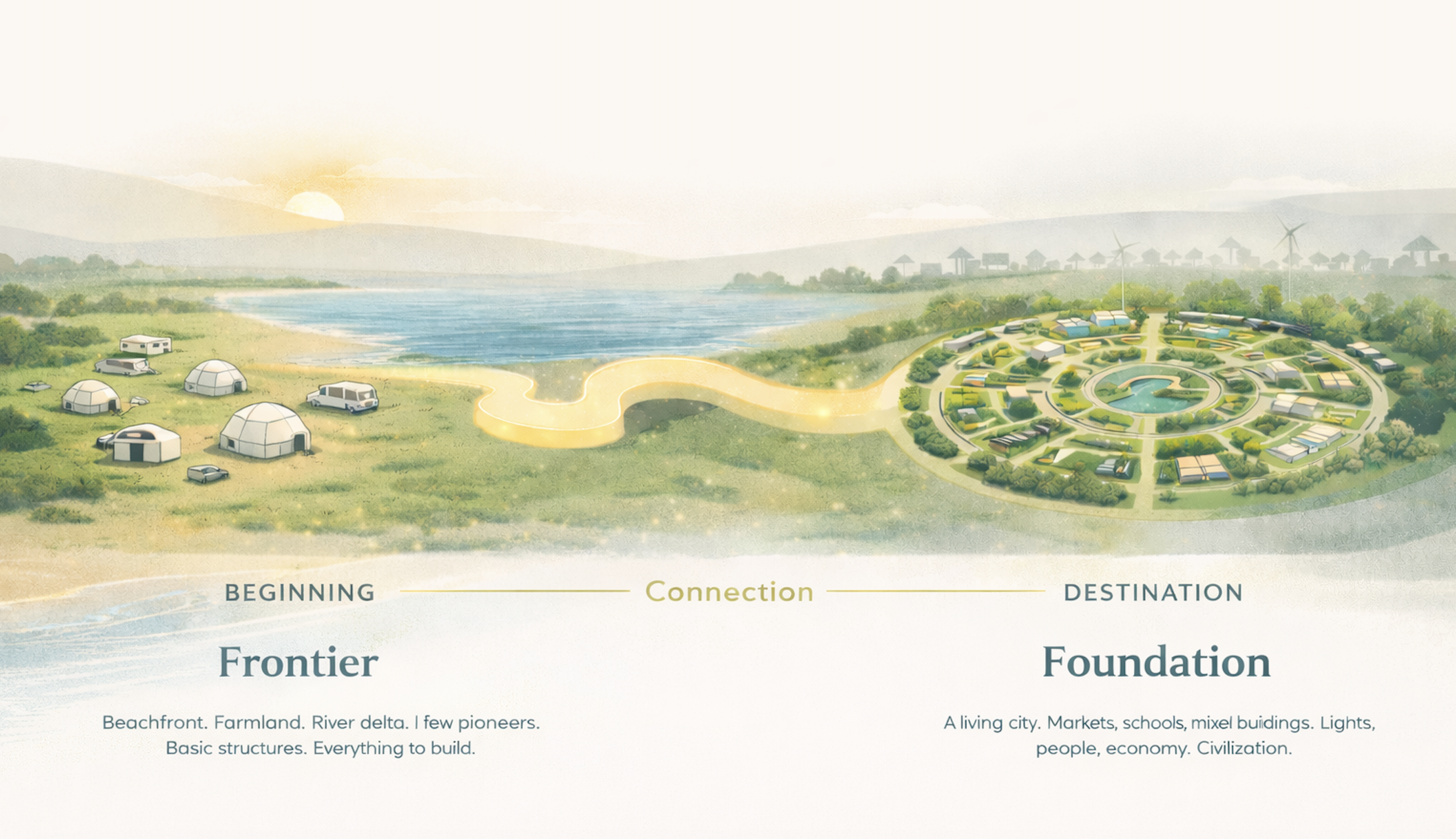
What is MVS
A one-year experiment to bridge the gap between pop-up villages and permanent cities, proving that a real, self-sustaining community of 1,000 paying members can be built from scratch in twelve months.
Inspired by the speed and participation of music festivals, MVS uses a subscription model and co-ownership from day one. Those who help build the town earn their plot of land through contribution and commitment.
A living community and a blank canvas sandbox for rethinking how society is built, designed to be open-source and replicable so anyone can create their own.
What makes up a Minimum Viable Society?
A society isn't built from a single idea, community or group — it's the sum of interconnected systems working together. We've broken MVS down into 10 domains that we believe are essential to reaching critical mass. To build something real, we need to bring together the experts, builders, and communities who are already leading the way in each one.
Three simultaneous shifts are converging:
Remote Work Liberation: The "city premium" is collapsing. People want affordable living + real community + nature.
Rural Land Crisis: Rural populations declining worldwide. Governments have billions in unused rural development funding.
Community Hunger: Around the world, tens of millions now gather annually in festivals, eco-villages, co-living spaces, and pop-up cities, signaling a clear shift toward intentional community as a way of life."
MVS is actively acquiring land in two of the world's most compelling regions for the first community — and we remain open to wherever the strongest conditions align.
Central America & The Caribbean
Countries like Costa Rica and the Caribbean islands offer year-round tropical climate, strong remote-worker infrastructure, affordable land, and governments actively welcoming international community development.
- Affordable coastal and rural land with strong development potential
- Thriving remote-worker and digital nomad ecosystems already in place
- Favourable residency and property ownership frameworks
- Year-round tropical climate ideal for outdoor community living
- Growing interest in sustainable and regenerative development
- English widely spoken; close proximity to North America
The Mediterranean
Southern Europe — spanning France, Spain, Portugal, Italy, and Greece — offers deep cultural roots, rural revitalization opportunities, and some of the most liveable climates in the world.
- Rural depopulation creating genuine revitalization opportunities
- Billions in EU rural regeneration funding already allocated
- Affordable land by Western European standards
- Deep cooperative and commons traditions
- Year-round climate ideal for living and production
- Close to major cities and international airports
- Geopolitically stable EU legal systems
MVS is designed as a global network of communities, not a single fixed location. We are actively evaluating properties in both regions and will share updates as land is confirmed.
We live in an age of extremes.
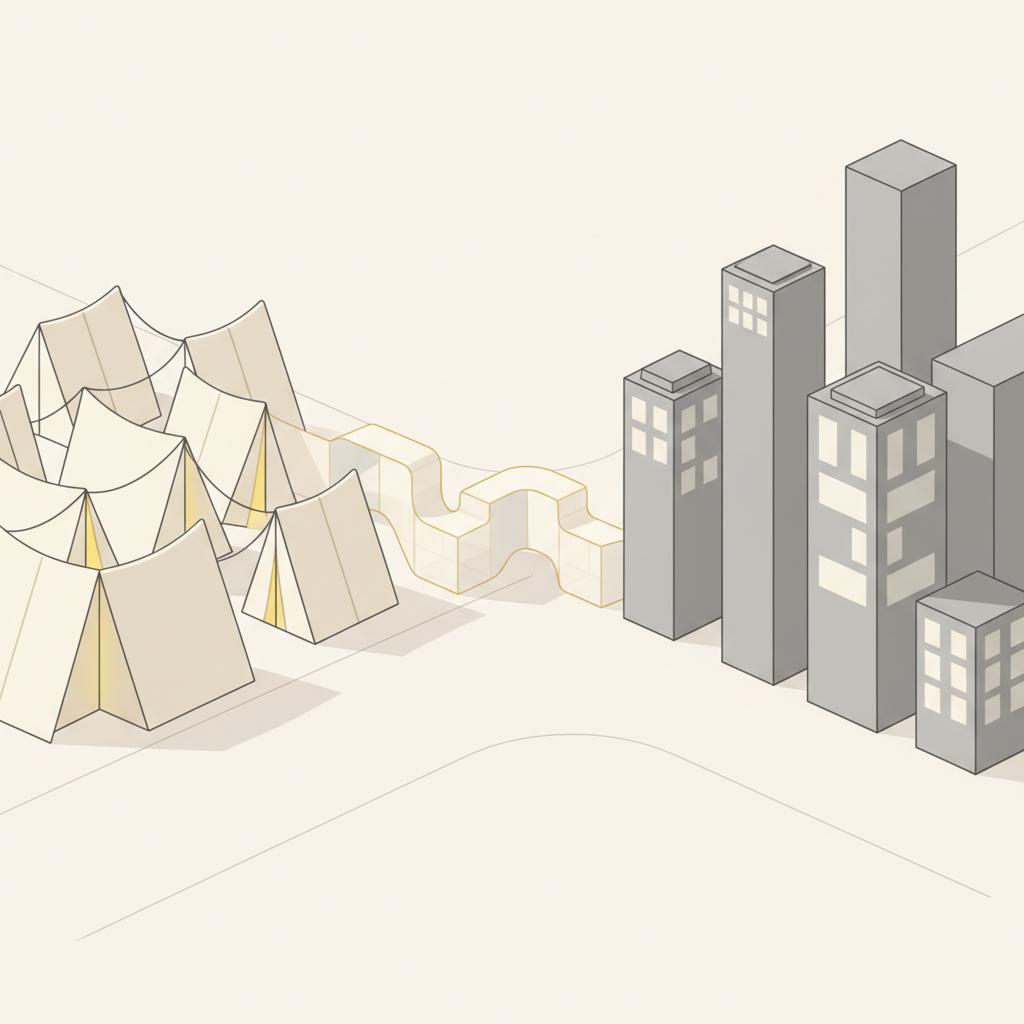
Pop-up villages (Zuzalu, Noma Collective, Burning Man) create magic in weeks. Real belonging forms. But they disappear before the community compounds. The culture evaporates. Everyone goes home.
Permanent cities (Serenbe, Prospera, traditional neighborhoods) last forever. Real culture builds. But they take 15-25 years and $100M-500M to create. Most people lose interest before the magic emerges. Momentum dies.
Intentional communities (Dancing Rabbit, Auroville and many eco-villages) excel at building deep culture and shared values, but they consistently plateau at 50–100 residents. Consensus-based governance struggles to scale, economic engines remain limited, and long-term viability depends on external funding. These communities also tend to attract highly similar participant profiles, resulting in cultural and professional monocultures that limit resilience, adaptability, and growth.
The gap between festival (2 weeks) and city (25 years) has no proven model.
This gap is where humanity wants to live and where we have zero institutional architecture to get there.
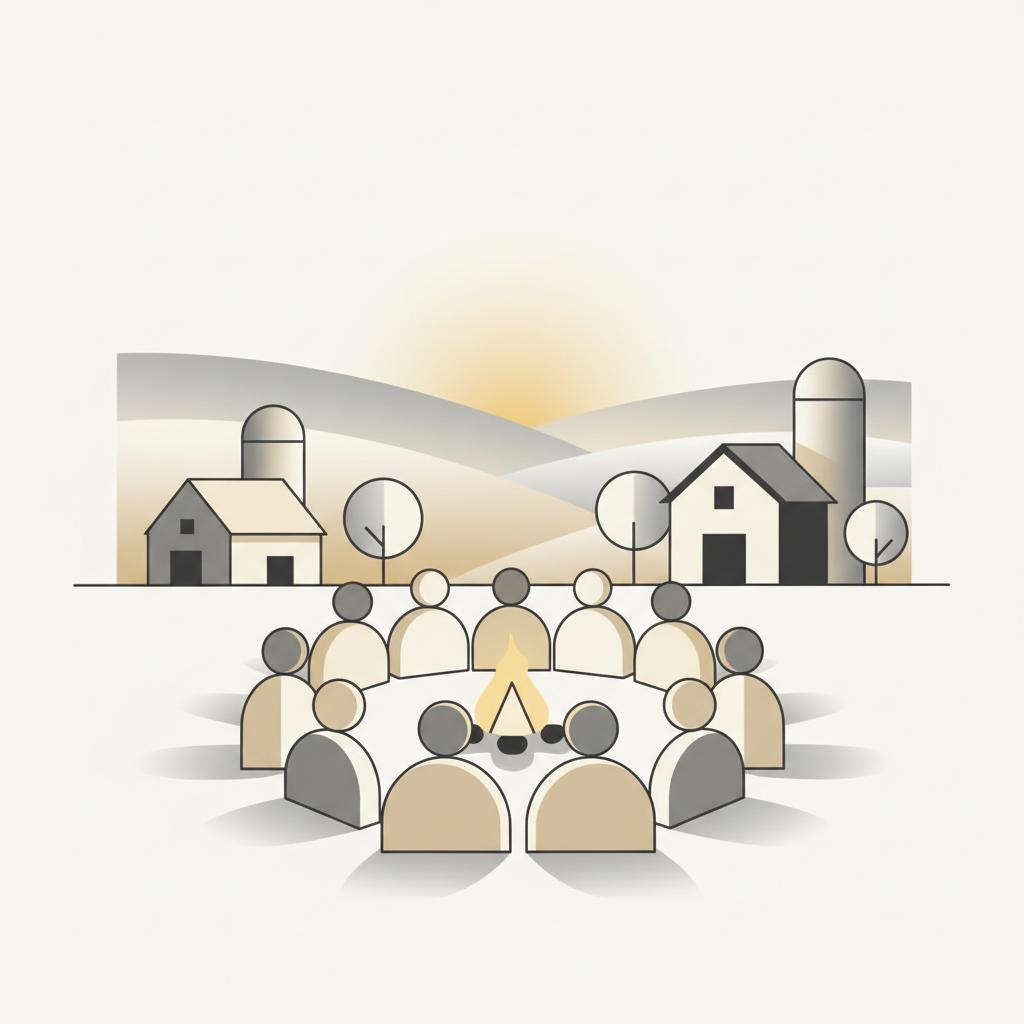
What if we could:
- Form real communities in 12-18 months (not 25 years)
- Use festival-speed infrastructure (proven at 70K+ scale)
- Enable subscription ownership (no down payment required)
- Scale beyond 150 people (via polycentric governance, not consensus gridlock)
- Build permanent affordability (land trusts prevent gentrification)
- Create economic engines ($24M+ revenue, self-sustaining)
- Replicate globally (open-source playbook, peer networks)
We can. Here’s how:
FOUR CORE PRINCIPLES
1. START WITH A GIFT
Land is gifted or subsidized by regional partners and MVS Patrons (removes $2-5M capital barrier).
Land is entered into a trust, and over 3 years sold off to subscription members. Patrons get return on investment.
This signals long-term commitment. Residents join a movement, not a product. Culture of contribution, not extraction.
For you: You don’t need $00K down payment. You pay subscription ($350-450/month). Over 3 years, your subscription vests into land ownership. You own a lot (400-1000m²) outright.
2. BUILD AT FESTIVAL SPEED
Use proven modular infrastructure: tension-fabric commons (Cirque du Soleil), solar microgrids, modular housing, containerized sanitation.
- 48 hours: Core utilities live (water, power, sanitation)
- 90 days: Full infrastructure (housing, commons, governance systems)
- 12-18 months: 1,000 residents thriving, culture embedded, self-sustaining
Fast enough to iterate. Permanent enough to matter.
3. PLURAL COMMUNITIES
A society does not form with a group of likeminded people. That will always create an imbalance and ultimately a monoculture.
For a society to form you need many different communities aligned on a higher moral and ethical standpoint.
MVS will bring together the brightest minds on the frontier of their industry.
The 10 Societal Functions are organized into the following Domains:
- Shelter and Spatial Systems
- Food, Water and Life Support
- Health and Human Care
- Education and Skill Transmission
- Economic Production and Livelihoods
- Governance, Law and Coordination
- Infrastructure and Systems Engineering
- Culture, Meaning and Social Fabric
- Safety, Security and Trust
- Stewardship and External Relations
4. ECONOMIC FLYWHEEL VIA SUBSCRIPTION AND OWNERSHIP
Residents pay $350-450/month (or choose a custom housing tier $200-1,000/month):
- Housing and utilities
- Governance and culture programming
- Land vesting and ownership path
- Access to community services
By Year 1: $12-14M revenue (realistic ramp), 40%+ margin by Year 2, fully self-sustaining.
By Year 3: $25K+ in personal land equity. Paid subscription, own a lot outright.
Governance: Beyond Dunbar's 150
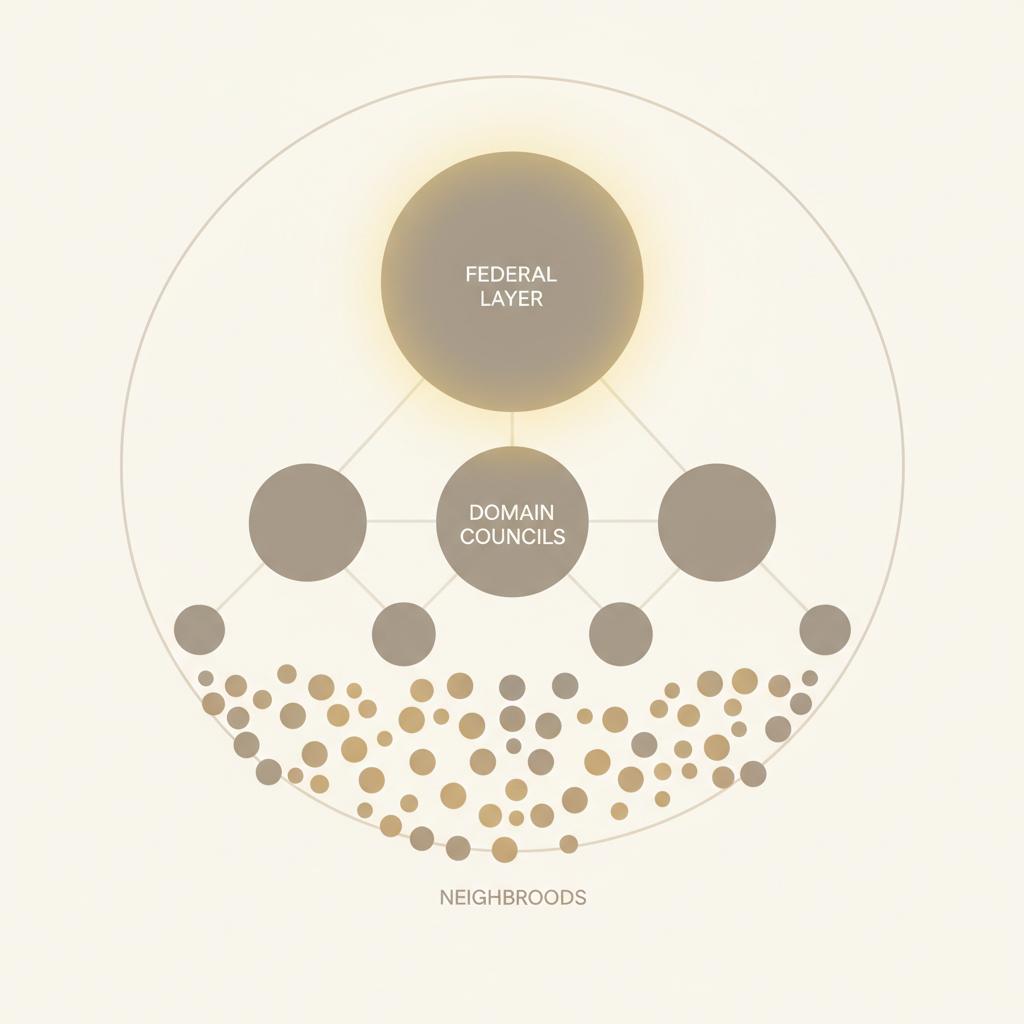
Consensus governance breaks down at 150-200 people. MVS uses Elinor Ostrom's polycentric architecture (Nobel Prize framework).
- Tier 1: Neighborhoods (30-150 people) use consensus
- Tier 2: Domain Councils (10 expertise areas) are expertise-driven
- Tier 3: Federal Layer handles constitutional governance
Result: 60%+ governance participation (vs. 20-30% traditional voting)
Ownership: Land Trust + Shared Equity
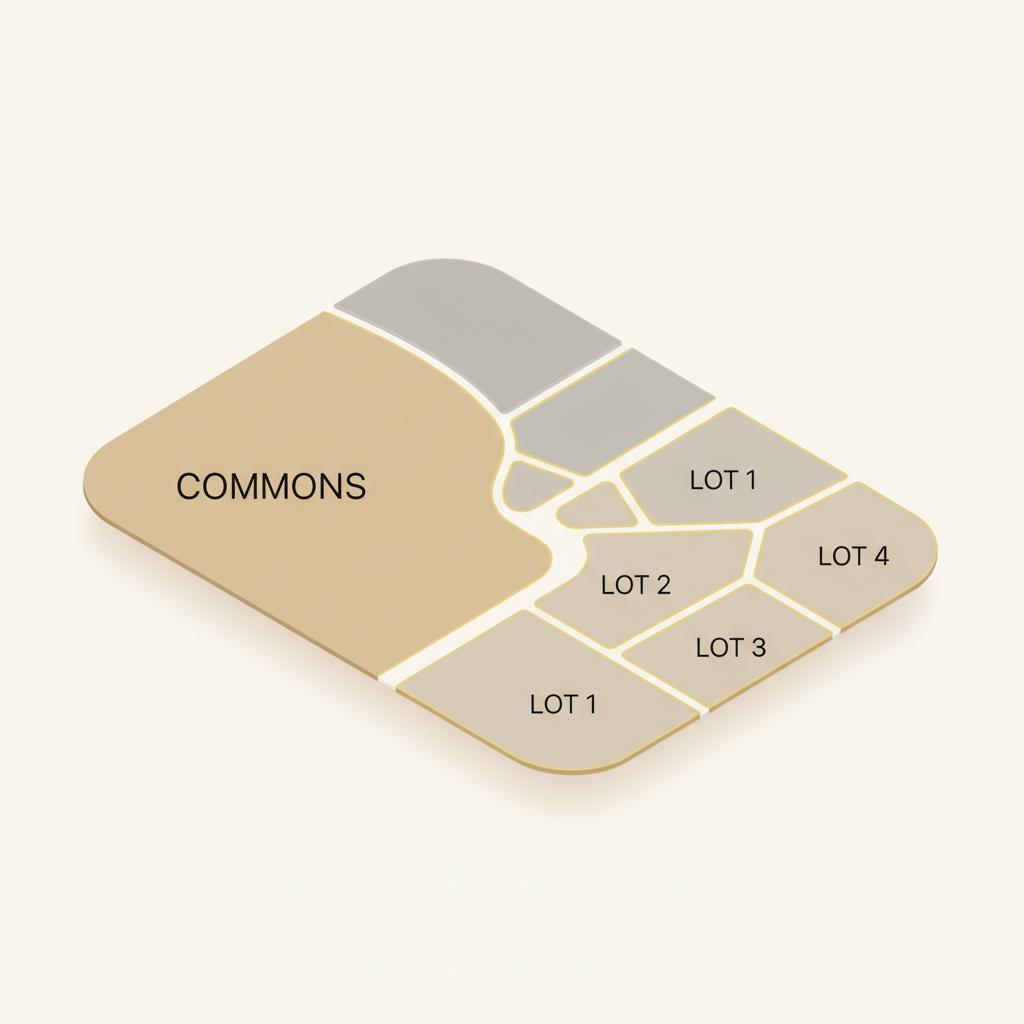
Community Land Trust model (proven in 500+ communities, 40+ year track record).
- Commons (40%): Town hall, kitchen, marketplace—held in perpetual trust
- Your Lot (60%): 400-1000m² residential property, fully owned after 3 years
You pay $450/month × 36 months = $16.2K. You earn $25K+ in land equity. You own a lot outright.
Multi-Generational Community
A deliberately multi-generational ecosystem integrating children, working adults, and elders as active contributors.
- Micro-schools (K-6) combining academics with regenerative learning
- Childcare: Neighborhood co-ops + central hub
- Aging-in-place with mentorship and stewardship roles
Outcome: By Year 3, 200-300 families alongside integrated elder population.
Local Integration
Structured revenue-sharing + co-governance (not charity).
- 40-50% local staff hiring at fair wages
- 60%+ food sourced locally ($2M+ contracts)
- 20%+ free/discounted access for neighbors
- Neighbors have 25% voting on major decisions
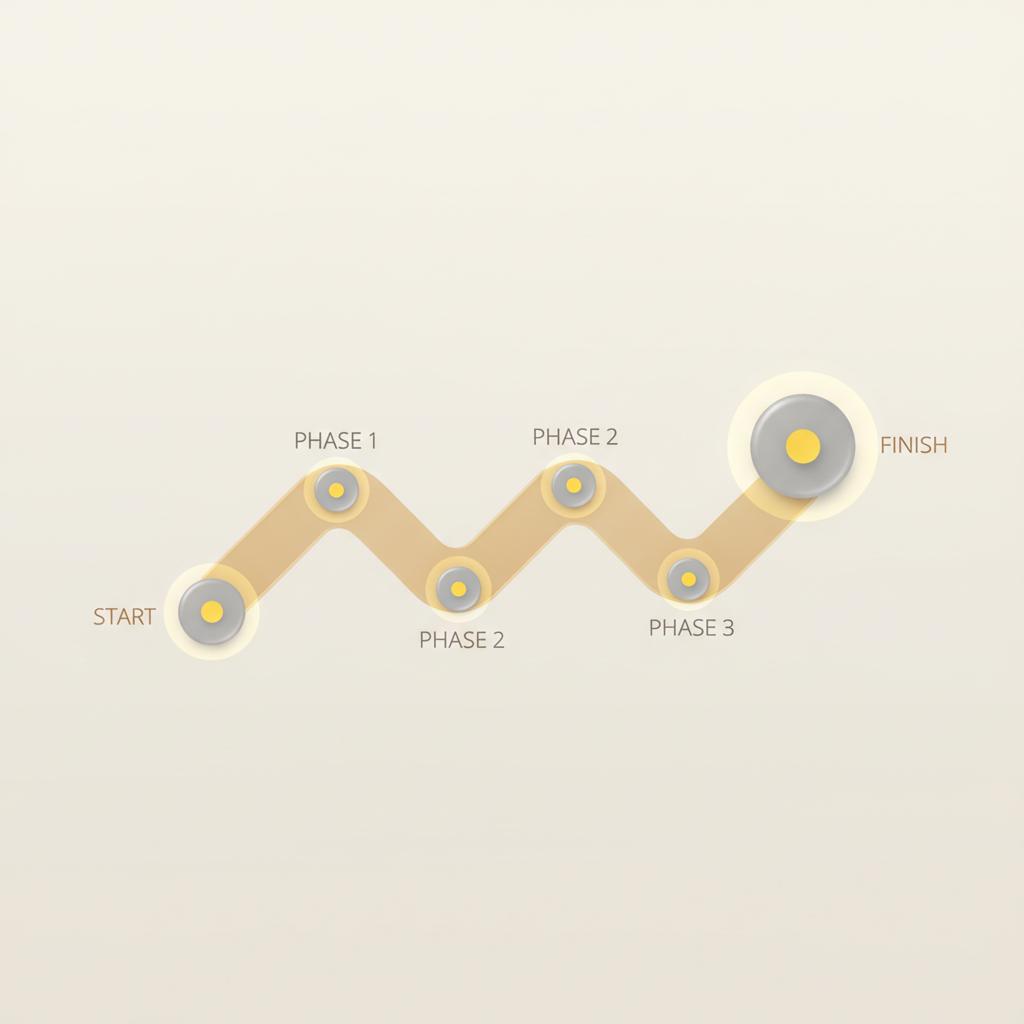
Phase 0: Pre-Season $1M
- Land legal structure (cooperative charter, land trust)
- Core team hired
- Community co-design (100+ founders)
- DAO formed with transparent treasury
Outcome: Legal + institutional foundation ready.
Phase 1: Pioneers $1M
- 48-72 hours: Core utilities live
- 50 pioneer residents arrive
- Town hall + kitchen operational
- First governance circles begin
Outcome: Proof that infrastructure deploys at festival speed.
Phase 2: Consolidate $3M
- Phased resident ramp: 50 → 150 → 500 → 1,000
- Infrastructure layers 2-3: Clinic, library, gym
- Families arrive: 200-300 by year-end
- Revenue ramp: $10K → $400K/month
Outcome: 1,000 residents thriving, self-sustaining financially.
Phase 3: Handover & Scale $1M
- Open-source field-kit v2.0 published
- Post-mortem published (failures + learnings)
- Site 2 launches with new leadership
- 3+ communities licensed globally
Outcome: Model proven replicable. Series A for 3-8 additional sites.
Economic Model
Minimum Viable Society operates on a simple principle:
Residents contribute an average of $400 per month to fund shared infrastructure, governance, and commons.
The projections above reflect the base subscription tier only. Once the land is secured and local providers and contributors are in place, MVS will layer in additional optional tiers and services, including housing partnerships, insurance, food systems, marketplace activity, and other community-based offerings, which add meaningful revenue and margin. These additional layers enhance the model, but are not required for viability. Even under the base subscription alone, the system reaches operational profitability within three years.
Infrastructure is deployed modularly at first with solar, water, waste, graded roads and then improves over time.
Residents build or upgrade their own homes.
MVS provides the backbone.
Year 1 Ramp (1,000 Residents by Year End)
| Phase | Residents | Monthly Revenue | Period Revenue |
|---|---|---|---|
| Months 1–3 | 150 | $74K | $223K |
| Months 4–6 | 350 | $174K | $521K |
| Months 7–9 | 650 | $323K | $968K |
| Months 10–12 | 1,000 | $496K | $1.488M |
Total Year 1 Revenue ≈ $3.2M
Year 1 focuses on deployment and proof.
3-Year Financial Overview
| Year | Avg Residents | Subscription Revenue | Operating Costs | Infrastructure (CapEx) | Free Cash Flow |
|---|---|---|---|---|---|
| Year 1 | 600 | $3.2M | $3.7M | $4.0M | –$4.5M |
| Year 2 | 2,250 | $10.8M | $7.8M | $6.0M | –$3.0M |
| Year 3 | 5,250 | $25.2M | $13.5M | $9.0M | +$2.7M |
By Year 3, the model becomes self-sustaining and cash-generative.
The projections above reflect the base subscription tier only. Once the land is secured and local providers and contributors are in place, MVS can introduce additional optional tiers and services, including housing partnerships, insurance, food systems, marketplace activity, and other community-based offerings. These layers add meaningful revenue and margin, but they are not required for the model to work. Even under the base subscription alone, the system becomes operationally profitable and free cash flow positive within three years.
The complete Minimum Viable Society vision, framework, and implementation strategy in one document.
What's Inside
- Full vision and proof points
- Detailed problem, opportunity, and solution analysis
- Four Core Principles with in-depth explanations
- All Breakthrough Innovations
- Complete 4-phase timeline
- Full financial model
- Early signup & participation sections
- Comprehensive FAQ
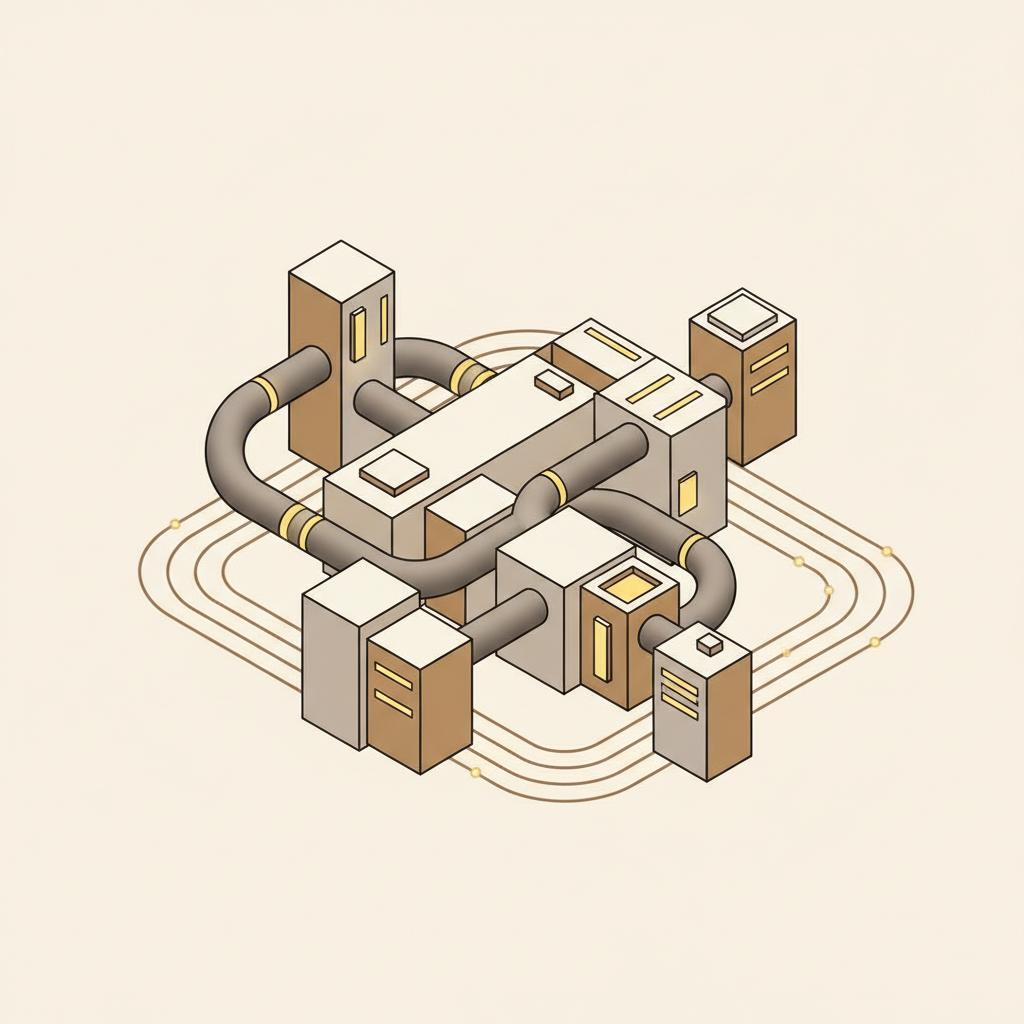
Infrastructure designed to allow for critical mass fast, then evolve into permanence.
The 4S Framework
- Speed: 48 hours to core utilities
- Standard: Interoperable modular components
- Self-Reliance: Local economy and energy
- Socialization: Dignity and governance support
Core Systems
MVS Direct
- Water System
- Power Microgrid
- Sanitation (WASH)
- Toolshed / Maker Space
- Digital & Communications
Partner Led
- Kitchen & Dining (Food Domain)
- Medical Point (SafetyWing)
- Library / Learning Lab (Education)
- Micro-schools (Education)
Priority Domains Seeking Contributors
- Shelter and Spatial Systems
- Food, Water and Life Support
- Health and Human Care
- Education and Skill Transmission
- Economic Production and Livelihoods
- Governance, Law and Coordination
- Infrastructure and Systems Engineering
- Culture, Meaning and Social Fabric
- Safety, Security and Trust
- Stewardship and External Relations
How is this different from other intentional communities?
Most communities plateau at 50-100 people (consensus governance breaks down). MVS uses polycentric nesting (proven at 1,000+ scale) + explicit multi generational integration. Most are dependent on external funding forever. MVS becomes self-sustaining ($10M+ margin Year 2).
What if governance breaks down?
Polycentric nesting prevents this. Small neighborhoods (30-150 people) use consensus. Larger decisions delegate to domain councils. Federal layer handles conflicts. Weekly feedback loops enable rapid adjustment.
Do I really own my lot?
Yes. After 3 years, your lot is fully owned. You can sell it (with community right of first refusal + formula pricing). You can build on it. You can will it to heirs. You own it.
What if I want to leave?
You can sell your lot (with right of first refusal + formula pricing). You exit cleanly. Subscription ends. No lock-in contracts. You own an actual asset.
How is this sustainable financially?
$12-14M Year 1 revenue. $15M operating costs. Breakeven to small profit Year 1. By Year 2, 3,000 residents = $30M revenue with $15M margin (40%).
Is this for me?
Yes, if you: Want to live in community, are comfortable with shared governance, can afford $350-450/month, want to own a lot.
Maybe not, if: You want total privacy, can't commit 2-3 hours/week to governance, prefer traditional real estate.
Explore MVS
Founder Thesis
The vision and reasoning behind building the Minimum Viable Society.
Litepaper
A comprehensive plan covering principles, timeline, and financial model.
Infrastructure
The 4S Framework for rapidly deployable, modular community systems.
Contributors
Meet the organizations and individuals building MVS together.